Tractatus
Figuring out what intelligence actually requires. Not by scaling LLMs. Somewhere between biology and brute-force engineering. ARC-AGI-3 is the test I measure against; below is what the loop has done so far, with receipts.
Tractatus says only what is the case, and shows the receipt.
The hardest test of fresh-environment reasoning. Every frontier LLM scored under 1% on it at launch. Only GPT-6 Astra saturates it, at $18,817 a run.
Inside my harness the same Astra clears ar25 8/8 cold at 7,704 output tokens. Before the slicing, inside my general loop, it needed 35,842. The harness does the thinking; the model only picks from what the harness offers, and every decision leaves a receipt. An open 285B model in the same seat has now cleared three full games cold, every forecast replayed. The player contains no game-specific content.
Next: the remaining public games on one frozen version, then the five reserved games, then the hidden set on Kaggle with the open model offline on one GPU.
Qwen3.8-Flash picking, cold from RESET, version 0916ai. The frames are the run's own observation log, not a replay. The counter shows how many picks the model had made.
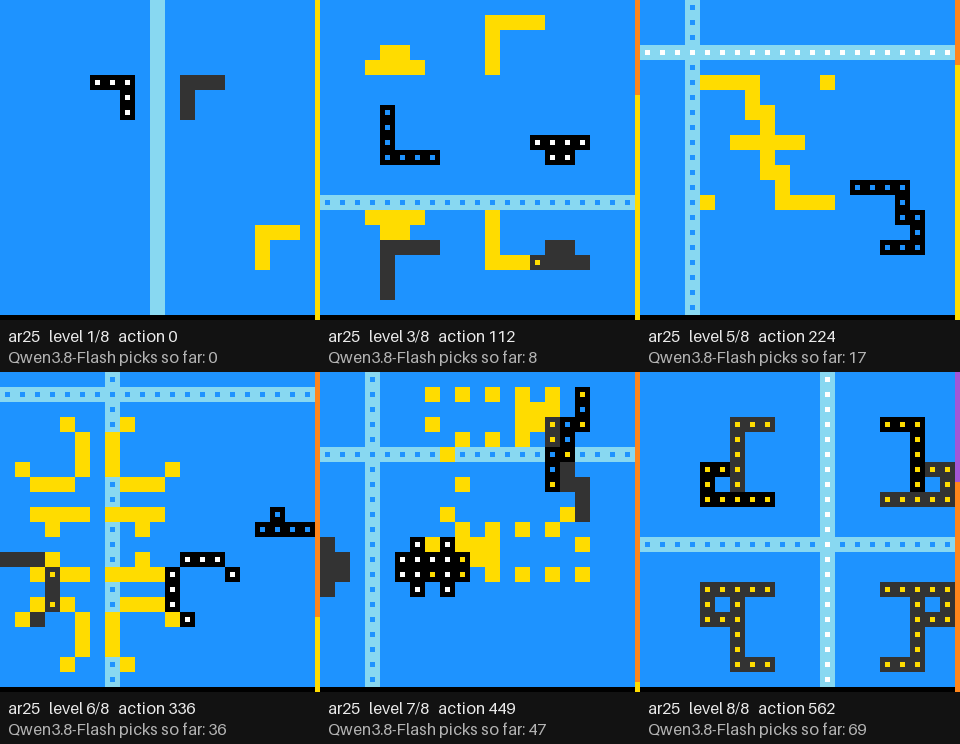
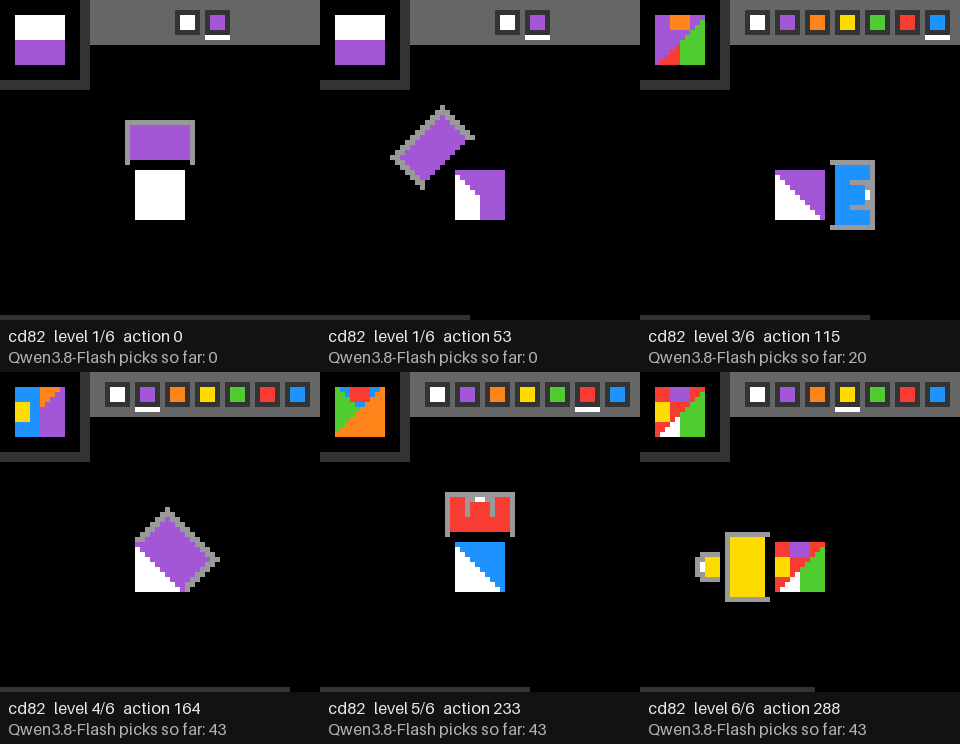
Same loop, different seats. Output tokens are the model's, reasoning included. Every observation and forecast in the Tractatus rows was replayed and verified.
| Run | Result | Calls | Output tokens | Note |
|---|---|---|---|---|
| GPT-6 Astra, ARC Prize's verified run, their harness | 99.9% semi-private | — | — | $18,817 for 55 games |
| GPT-6 Astra inside my loop, unsliced | ar25 8/8 | — | 35,842 | all 25 public games played: 22 complete, tu93, vc33 and wa30 stopped by me mid-run; no game-specific content |
| GPT-6 Astra inside Tractatus, picks only | ar25 8/8 cold | 93 | 7,704 | 604 observations and 257 forecasts replayed |
| Open 285B model (Qwen3.8-Flash) inside Tractatus, picks only | ar25 8/8 cold | 69 | 28,399 | 562 actions, 258/258 forecasts replayed, version 0916ai |
| Open 285B model inside Tractatus, picks only | cd82 6/6 cold | 43 | 26,249 | 288 actions, 66/66 forecasts replayed, same version |
| Open 285B model inside Tractatus, picks only | tr87 6/6 cold | 43 | 17,439 | 237 actions, 148/148 forecasts replayed, same version |
Public-set results are development receipts, not ARC Prize verification. The hidden set is the test, on Kaggle, with the open model offline.
GPT-6 Astra inside the general loop before slicing: one chain per game, no game-specific content, all 25 public games. Levels are where each chain ended. Five games are reserved: the sliced loop, Tractatus, has never been run or repaired on them, so they are the test at the freeze. ▶ watch is the open model's own cold clear of a game, frames from the run.
| Game | Levels | Status |
|---|---|---|
| ar25 ▶ watch | 8/8 | complete |
| cd82 ▶ watch | 6/6 | complete |
| tr87 ▶ watch | 6/6 | complete |
| bp35 | 9/9 | complete |
| su15 | 9/9 | complete |
| sk48 | 8/8 | complete |
| lp85 | 8/8 | complete |
| sb26 | 8/8 | complete |
| s5i5 | 8/8 | complete |
| re86 | 8/8 | complete |
| ka59 | 7/7 | complete |
| g50t | 7/7 | complete |
| ls20 | 7/7 | complete |
| tn36 | 7/7 | complete |
| sc25 | 6/6 | complete |
| cn04 | 6/6 | complete |
| m0r0 | 6/6 | complete |
| dc22 | 6/6 | complete |
| lf52 | 10/10 | complete · reserved |
| r11l | 6/6 | complete · reserved |
| ft09 | 6/6 | complete · reserved |
| sp80 | 6/6 | complete · reserved |
| tu93 | 6/9 | stopped by me |
| vc33 | 6/7 | stopped by me · reserved |
| wa30 | 4/9 | stopped by me |
25 of 25 played, 22 complete, 174 of 183 levels. The three unfinished chains were stopped by me once I had the maps I needed, not by a failed level. Only ar25 has a clean token count; the other chains include the map-writing Astra did while it played.